
Skip to content

How it works

Six steps, in the order they were done.

Only steps that were photographed or recorded appear here. Where a detail was not written down, we say so instead of filling the gap.

Six steps, in the order they were done.

Before stage 01

Ask before building

Residents and the kelurahan were consulted before any design was drawn. What they asked for shaped what was made. One request, a night-watch post, was declined.

What we do not doWe do not start from a design. The night-watch post was declined because the material could not build it well.

Evidence: Founder record; production brief 2026

Select a stage, or use the left and right arrow keys, to read the documented note.

The same steps, as a plain list

Before stage 01

Ask before building

Residents and the kelurahan were consulted before any design was drawn. What they asked for shaped what was made. One request, a night-watch post, was declined.

What we do not doWe do not start from a design. The night-watch post was declined because the material could not build it well.

Evidence: Founder record; production brief 2026

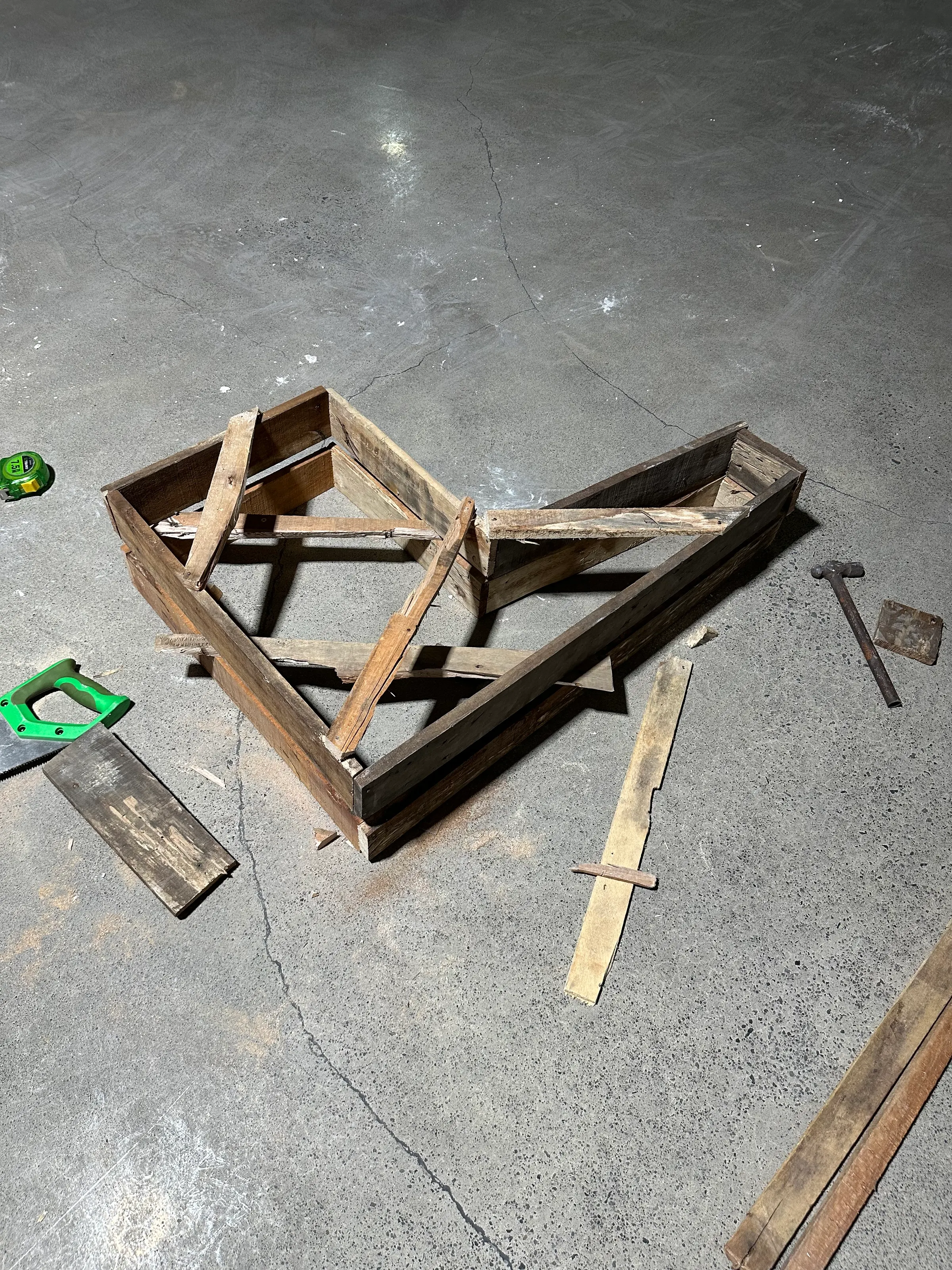
A rectangular timber frame with diagonal braces on a concrete floor, a hammer and saw beside it.
Timber formwork for a bench base, built from offcut planks before any concrete or tile.· Workshop at the family depot, Tasikmalaya
  1. 01

    Sort by condition

    The material is unsellable floor tile, paving and brick from a family building-materials depot. Pieces with a sound body and one broken edge are kept. Sharp, crumbling or badly cracked pieces are rejected.

    What we do not doWe did not record weights, so we publish no weight figures.

    Evidence: Photographs, 2026

  2. 02

    Cut and weld steel

    New steel section is cut with an angle grinder and welded into the frames of the sorting units. Rebar offcuts are welded to reinforce the benches.

    What we do not doWe do not call the frames reclaimed. The steel section is new; only the rebar is offcuts.

    Evidence: Photographs, 2026

  3. 03

    Tie the grid

    Rebar grids are tied together with wire by hand. The formwork that will hold the concrete is built from offcut planks.

    What we do not doWe publish no reinforcement specification. Grid spacing was set by the makers on the day and was not recorded.

    Evidence: Photographs, 2026

  4. 04

    Form and pour

    Concrete is mixed by hand in a wheelbarrow. It is poured into the timber formwork around the tied grid.

    What we do not doWe publish no mix proportions or timings here. Inventing them would be worse than leaving them out.

    Evidence: Photographs, 2026

  5. 05

    Press the tile

    Tile fragments are pressed glazed-side up into the wet concrete and set flush with the surface. The reclaimed material is only ever the surface.

    What we do not doWe never let reclaimed tile carry load. The steel and concrete do that.

    Evidence: Photographs, 2026

  6. 06

    Finish and place

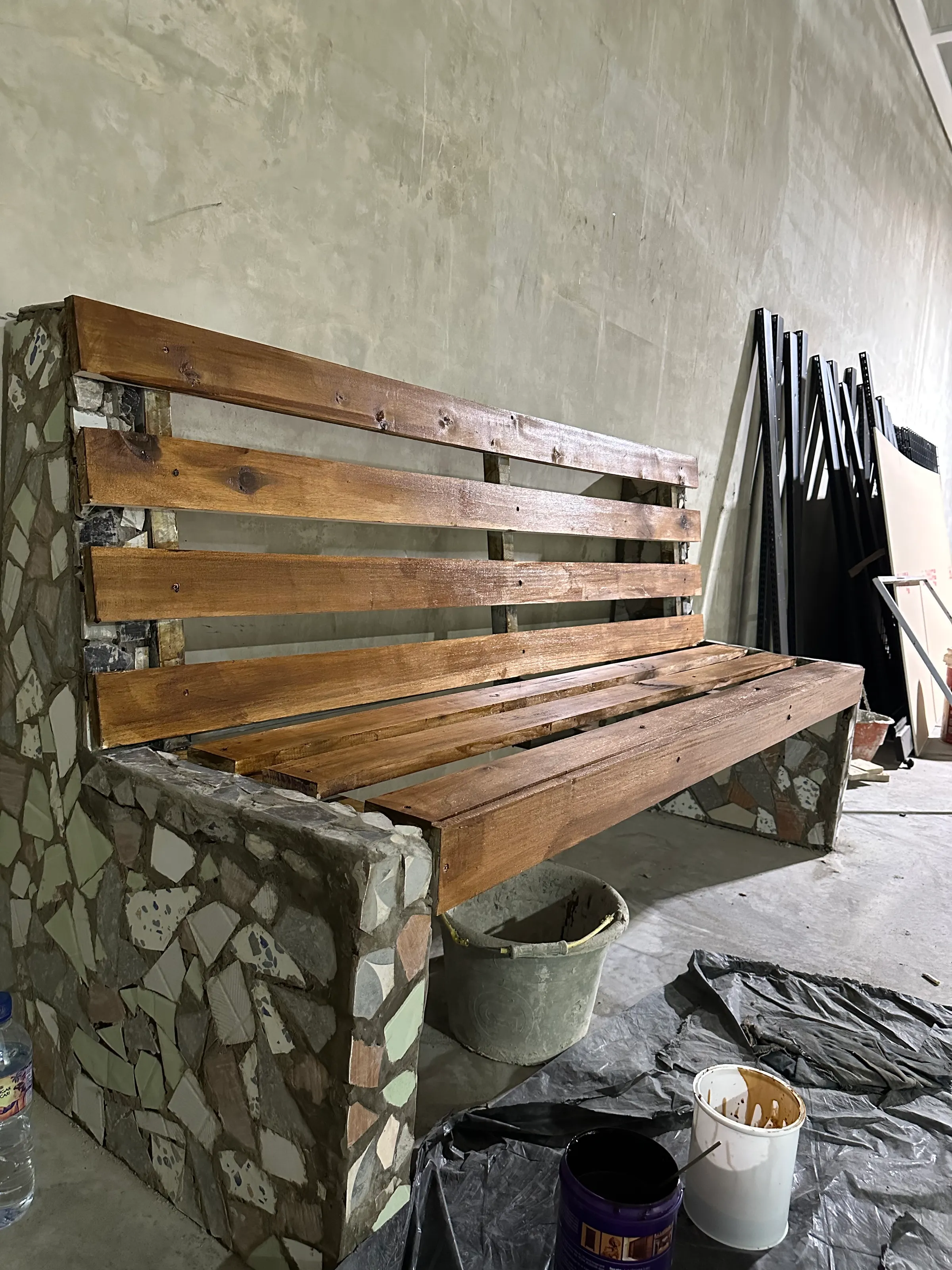
    Timber slats are sanded and varnished. One substandard paint finish was redone on site after the founder reviewed daily photographs from Shenzhen. The first chairs were sat on for three days before handover, and units travelled by pick-up to the kelurahan. In 2026, nine units stood in public areas, according to project records and a letter from the kelurahan head.

    What we do not doWe claim no load test, because none was done. The three-day sit is the only test on record.

    Evidence: Photographs and video · founder record

Production budget · per piece

What one piece costs to make.

Figures used · per the project owner

The per-piece production budget covers materials, labour and upkeep for one bin and one bench. The project owner states that these are the figures actually used to make the units. They come from the budget document, not from receipts, and a total for the nine installed units is not published yet. The kilograms follow the same document: ceramic prepared, and the target left in place. No separate weighing record is on file.

Source: the project's own production budget (2026). The project owner confirmed that these are the figures used.

Sorting bin

One free-standing container: steel frame, ceramic mosaic skin and an inner container that lifts out.

Plan drawing, not a built unit

Rp 750,000

Budget ceiling per piece, including 10% contingency

Materials and hardware
Rp 391,800
Labour
Rp 240,000
Electricity, water and transport
Rp 47,000
Contingency 10%
Rp 67,880
Planned outer size
40 × 40 × 70 cm
Ceramic prepared
17 kg
Target ceramic in place
15 kg
Labour
1.5 person-days

Ceramic per piece17 kg prepared − 1 kg left whole − 1 kg lost in the process = 15 kg target in place

Full breakdown
Sorting bin: Full breakdown
ComponentQuantityAmount
Broken ceramic from leftover stock17 kgRp 0
Hollow steel frame, 30 × 30 × 1.2 mm8 mRp 144,000
Moisture-resistant base panel for the cladding0.96 m²Rp 52,800
Removable inner container1 pcRp 60,000
Tile adhesive6 kgRp 42,000
Grout1 kgRp 20,000
Primer, paint and protective coat1 setRp 35,000
Bolts, feet and category label1 setRp 18,000
Welding rods, sandpaper and cutting discs1 allowanceRp 20,000
Maker's wage: frame and mosaic1 person-dayRp 180,000
Helper's wage: sorting and washing0.5 person-dayRp 60,000
Workshop electricity and water1 allowanceRp 12,000
Local transport and installation1 allowanceRp 35,000
Production subtotalRp 678,800
Contingency 10%Rp 67,880
Total before roundingRp 746,680

The frame length already includes working offcuts. A person-day is eight working hours; curing time follows the material used and is not counted as active work.
Bench

A backless bench with a steel frame and a mosaic seat.

Plan drawing, not a built unit

Rp 980,000

Budget ceiling per piece, including 10% contingency

Materials and hardware
Rp 471,000
Labour
Rp 360,000
Electricity, water and transport
Rp 55,000
Contingency 10%
Rp 88,600
Planned outer size
120 × 40 × 45 cm
Ceramic prepared
14 kg
Target ceramic in place
12 kg
Labour
2.25 person-days

Ceramic per piece14 kg prepared − 1 kg left whole − 1 kg lost in the process = 12 kg target in place

Full breakdown
Bench: Full breakdown
ComponentQuantityAmount
Broken ceramic from leftover stock14 kgRp 0
Hollow steel frame, 40 × 40 × 1.6 mm10 mRp 250,000
Base panel and seat supports1 setRp 50,000
Tile adhesive8 kgRp 56,000
Grout1.5 kgRp 30,000
Primer, paint and protective coat1 setRp 40,000
Feet, bolts and end caps4 setsRp 20,000
Welding rods, sandpaper and cutting discs1 allowanceRp 25,000
Maker's wage: frame and mosaic1.5 person-daysRp 270,000
Helper's wage: sorting and washing0.75 person-dayRp 90,000
Workshop electricity and water1 allowanceRp 15,000
Local transport and installation1 allowanceRp 40,000
Production subtotalRp 886,000
Contingency 10%Rp 88,600
Total before roundingRp 974,600

The seat panel works together with the supporting frame. Joint details and the spacing of supports are set by the maker before building.

If built as a sorting set of three

Rp 2,250,000

Three free-standing bins: organic, plastic and residual. The budget is three times the bin; savings from building them together are not yet counted.

Planned sequence, workshop to shared space

  1. 01

    Preparing material

    Sort, wash and weigh the dry ceramic. Set aside sharp edges and brittle pieces.

  2. 02

    Assembly and finishing

    Build the frame, fit the base, lay the ceramic, grout, and coat the steel.

  3. 03

    Check before delivery

    Check joints, stability, edges, loose ceramic and access for emptying.

  4. 04

    Handover

    Give every unit an ID; record its location, recipient, date and a photograph in place.

Planned upkeep in the field

Emptying the bins
Local cleaning staff together with the RT/RW coordinator. Daily to begin with, and sooner when a bin is three-quarters full. Where the waste goes is recorded at handover.
Inspecting the units
Weekly, and after heavy rain. Photograph ceramic, grout, paint, frame and feet. A unit that is not stable is taken out of use until it is repaired.

What the budget assumes

  • Volumes, sizes, wages and allowances are as set in the budget document; the project owner states they are the figures used.
  • Leftover ceramic is assumed to cost nothing to buy, and the main tools are already available.
  • Donated value and the purchase of new tools are not in the totals.
  • Transport is a shared-trip allowance; tax on purchases follows the supplier.

Where to see the result

Each project page lists its materials, what is verified and what is still pending, with photographs as evidence.

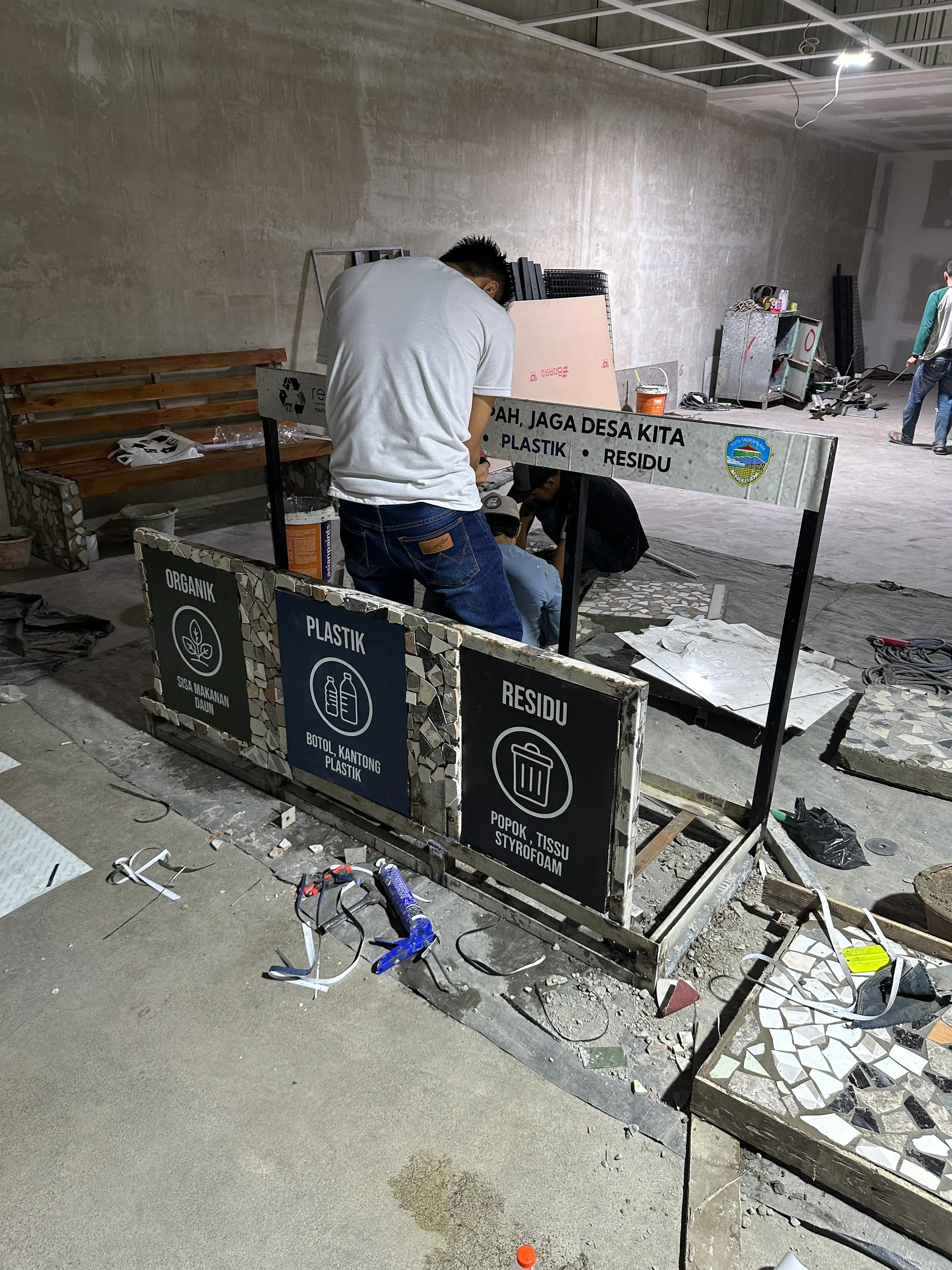
A steel-framed waste station with three dark signboards reading ORGANIK, PLASTIK and RESIDU above tiled compartments; two workers seen from behind.
A sorting unit assembled in the workshop: three labelled sections (organik · plastik · residu) on a mosaic-clad base, with the sign "Pilah sampah, jaga desa kita".· Workshop at the family depot, Tasikmalaya
A bench with warm varnished timber slats and a backrest, its supports clad in a mosaic of broken tiles.
The same bench after sanding and varnishing, 2026.· Workshop at the family depot, Tasikmalaya